Professional Nail Preparation to Prevent Product Lifting
Professional nail prep and application techniques ensure maximum adhesion and prevent lifting during gel or acrylic services. Proper nail plate dehydration, cuticle clearing, and correct product placement are essential for long-lasting durability and client safety in a professional US salon environment.
The Critical Role of the Dry Manicure
Achieving long-term nail retention begins with a thorough dry manicure. Water-soaked nails expand and then contract after service, causing the product to pull away from the natural plate.
Technicians must focus on removing the true cuticle, which is the thin layer of dead skin attached to the nail plate. This non-living tissue is the leading cause of lifting if not fully cleared.
- Pushing back the eponychium to reveal the hidden cuticle.
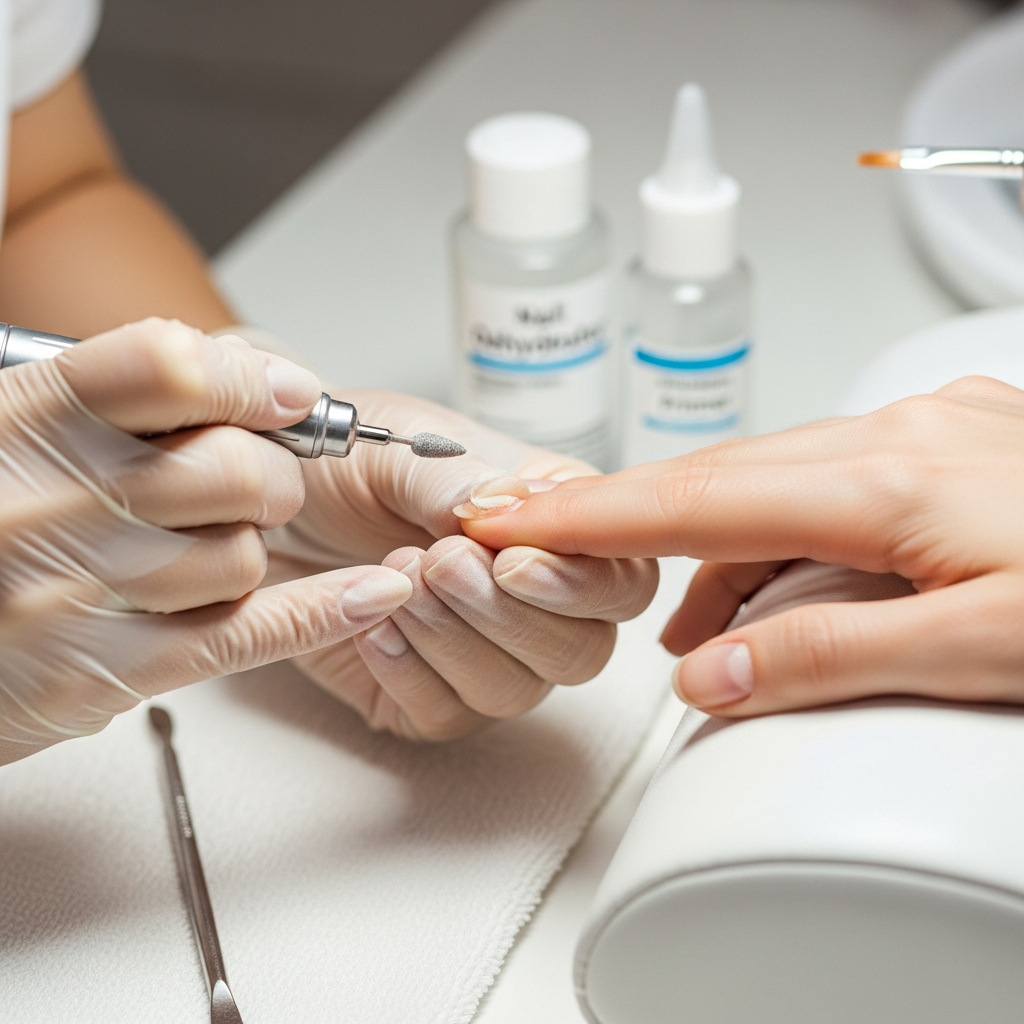
- Using a high-quality pusher or an electric file bit at low RPM.
- Clearing the lateral folds where debris often accumulates.
Surface Dehydration and pH Balancing
The natural nail plate contains oils and moisture that act as a barrier to professional bonding agents. A clean, dehydrated surface is required for chemical mechanical bonds to form correctly.
After mechanical buffing with a high-grit file, a professional dehydrator should be applied. This temporary moisture removal allows the primer to penetrate the dorsal layers of the nail plate.
Acid or non-acid primers act as double-sided tape, creating a bridge between the keratin of the nail and the enhancement material. Use these sparingly to avoid chemical overexposure.
Precise Product Application and Perimeter Control
Lifting often occurs when the product is applied too close to the soft tissue. If the gel or acrylic touches the skin, it creates a ledge that pulls the material away as it grows.
Maintain a tiny gap, roughly the thickness of a hair, between the product and the proximal nail fold. This allows for a seamless transition and prevents the product from catching on hair or clothing.
- Taper the product thin at the cuticle area and side walls.
- Ensure the apex is positioned correctly for structural support.
- Seal the free edge to prevent moisture from entering the layers.
Consistency in Polymerization and Curing
Incomplete polymerization weakens the nail enhancement, making it prone to cracking and lifting. This is often caused by incorrect mixing ratios in acrylic or under-curing in gel services.
Always use the specific lamp calibrated for your gel system to ensure the photo-initiators react fully. For acrylic, ensure the bead is not too wet, as excess monomer increases shrinkage and lifting.
Troubleshooting Common Technical Errors
If lifting occurs at the free edge, it usually indicates the nail was not capped or the client has thin, flexible nails. If lifting occurs at the cuticle, it points to poor prep or skin contact.
Consistent results require a disciplined approach to every step of the service. Refining these technical skills ensures a high standard of durability for every client.
