Optimizing Professional Nail Salon Workflows for Profit
In the competitive United States nail market, the difference between a struggling salon and a highly profitable business often comes down to minutes.
Efficiency in a nail salon is not about rushing the client or cutting corners on safety.
It is about eliminating wasted movement and standardizing technical execution.
Every second a technician spends searching for a clean e-file bit or a specific gel polish color is a second of lost revenue.
For salon owners and managers, creating a structured system for service delivery is the most effective way to increase the daily client count.
This article breaks down the professional workflows required to maximize output while maintaining the highest industry standards.
The Ergonomics of a High-Performance Nail Station
A professional nail workflow begins with the physical layout of the technician’s desk.
Improper station organization leads to physical fatigue and repetitive strain injuries, which ultimately slow down service speed.
The most efficient technicians utilize a “reach zone” philosophy where the most frequently used items are within six inches of their dominant hand.
The nail lamp should be positioned to allow the client to place their hand inside without overextending their arm.
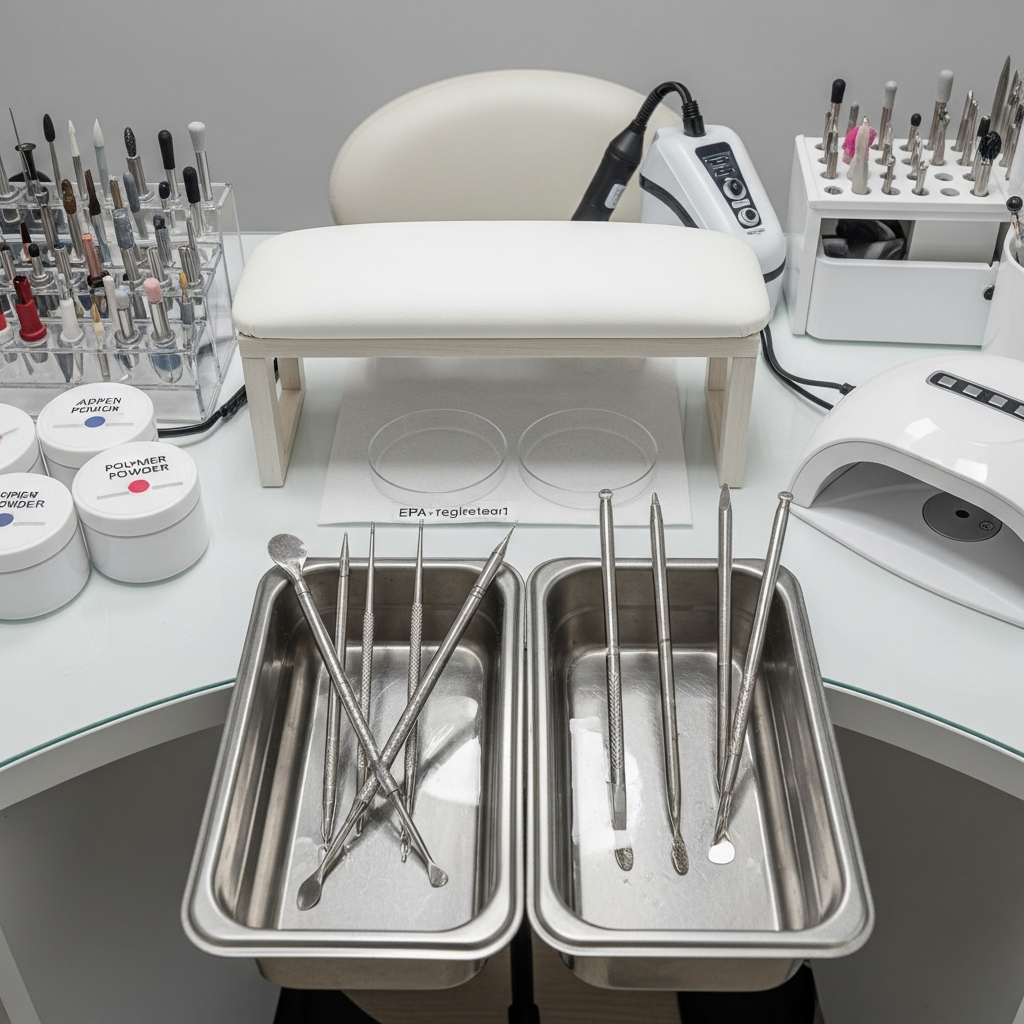
Dappen dishes for monomer and containers for polymer powder must be placed on the side of the technician’s dominant hand to prevent crossing the body.
This setup reduces the physical toll on the tech and ensures a faster application process during acrylic services.
Lighting is another critical component of the workflow.
High-intensity, flicker-free LED lamps should be positioned to eliminate shadows on the nail plate.
Clear visibility allows for precise product placement near the eponychium, reducing the time needed for finishing and filing later in the service.
Standardizing the Professional Prep Phase
Nail enhancement longevity depends entirely on the quality of the preparation phase.
However, many technicians spend far too much time on prep by repeating steps or using inefficient tools.
A standardized prep workflow should take no longer than 10 to 12 minutes for a full set or a fill-in.
Using a professional e-file with high-quality carbide or diamond bits is essential for modern salon efficiency.
Instead of manual buffing, a fine-grit diamond bit can gently remove the shine from the natural nail plate and refine the cuticle area in a single pass.
This consistency ensures that every client receives the same level of service, regardless of which technician they see.
Technicians must be trained to follow a specific finger-by-finger sequence.
Starting with the pinky of the left hand and moving across to the right ensures that no finger is missed.
This eliminates the need to double-check work, which is a common time-waster in busy salon environments.
Advanced Product Application and Ratio Control
For liquid and powder (acrylic) services, mastering the mix ratio is the key to speed.
A bead that is too wet will run into the side walls, requiring extensive cleanup and filing time.
A bead that is too dry will not self-level, resulting in a lumpy surface that demands extra labor to smooth out.
Professional nail technicians should aim for a “three-bead application” or, for advanced techs, a “one-bead method.”
By controlling the placement of the apex and the thinness of the free edge during the wet phase, the technician minimizes the work required during the finishing stage.
Proper application should result in a nail that looks nearly finished before a file ever touches it.
In gel services, the use of builder gel in a bottle (BIAB) has revolutionized salon workflows.
These products allow for a faster application than traditional potted gels while providing the strength required for natural nail overlays.
Implementing a flash-cure step during complex nail art or structural builds can also prevent product movement, ensuring the final result is crisp and professional.
The 10-Minute Finishing Rule
Filing and shaping should be the most predictable part of any nail service.
Many technicians lose profitability by over-filing or repeatedly changing the shape of the nail.
A professional workflow dictates that the shape is established during the prep or tip-application phase, not at the end of the service.
Using a high-grit hand file for the side walls and the free edge, followed by an e-file for the surface area, is the fastest way to achieve a professional finish.
The goal is to follow a “shaping map”: side walls, free edge, cuticle area, and then the surface contour.
By following this map on every finger, the technician develops muscle memory that naturally increases speed over time.
Dust management during this phase is also a workflow concern.
Integrated desk dust collectors prevent the accumulation of debris on the workspace, which saves time on cleanup between clients.
A clean environment allows for a faster transition to the polishing or top-coat phase without the risk of contamination.
Sanitation Protocols as a Time-Saving Strategy
In the United States, State Board compliance is non-negotiable.
However, sanitation is often viewed as a “break” in the workflow rather than a part of it.
Successful salon owners integrate sanitation into the turnover process to ensure safety without dragging down the schedule.
Implementing a “dual-set” system for implements is a standard best practice.
While one set of metal tools is being scrubbed and submerged in an EPA-registered disinfectant, the technician should have a second, fully sterilized set ready for the next client.
This removes the wait time associated with the mandatory 10-minute disinfection soak required by most state regulations.
Workstation surfaces should be non-porous and easy to wipe down.
Using disposable table towels or lint-free wipes allows for a quick reset of the station.
A clear, documented sanitation checklist helps staff maintain these standards during peak hours without needing constant supervision from management.
Improving Revenue Through Service Timing
To maximize a salon’s earning potential, management must set clear time targets for every service offered.
A standard gel manicure should ideally be completed in 45 minutes, while a full set of acrylics should not exceed 75 to 90 minutes.
If technicians are consistently over these times, it indicates a breakdown in the workflow or a need for technical retraining.
Owners should conduct regular “time audits” where they observe the workflow of their senior staff.
Common bottlenecks include slow polish selection by the client, excessive “social” talking that stops the technician’s hands, or inefficient e-file usage.
Addressing these specific points through a salon management solution or a structured training program can reclaim several hours of billable time each week.
Client management is also a factor.
Encouraging clients to choose their color from a swatch book while they wait or during the removal process prevents the “choice paralysis” that often stalls an appointment.
This small adjustment to the client flow can save five to ten minutes per service.
Staff Training and Quality Consistency
A salon’s reputation is built on consistency.
If a client receives a perfect set of nails from one technician but a sub-par set from another, the business model is flawed.
Standardizing the technical steps across the entire team is the only way to ensure brand reliability.
Professional nail salons should hold monthly workshops to refine specific skills, such as apex placement or efficient e-file cuticle work.
Using a “lead technician” to mentor newer staff ensures that the salon’s specific workflow is adopted by everyone.
This leadership-driven approach creates a culture of professional excellence and accountability.
Focusing on the “why” behind each step helps technicians understand the importance of the workflow.
For instance, explaining the chemistry of the inhibition layer on gel products helps them understand why certain wiping techniques are necessary.
Deep technical knowledge leads to fewer service breakdowns and fewer unpaid “fix-it” appointments, which are a major drain on salon profits.
Conclusion: The Path to Operational Excellence
Optimizing a nail salon’s workflow is a continuous process of refinement.
By focusing on station ergonomics, standardized prep, precise product application, and integrated sanitation, salons can significantly increase their throughput.
This approach does not just benefit the bottom line; it also improves the work environment for technicians and the experience for clients.
In the professional nail industry, time is truly the most valuable commodity.
Applying a structured system to every service ensures that every minute is spent creating value.
For the salon owner, this level of operational discipline is what separates a high-end, profitable establishment from the rest of the market.
By investing in staff education and maintaining rigorous standards, a nail salon can achieve a balance of speed, safety, and artistry.
The result is a sustainable business that thrives on professional reputation and efficient execution.
