Maximizing Nail Salon Efficiency and Service Consistency
Operational efficiency is the cornerstone of a profitable nail salon in the United States.
In a market where labor costs are rising, salon owners must focus on maximizing the output of every nail technician.
Efficiency does not mean rushing through a service; it means eliminating wasted movement and optimizing the nail workflow.
Every minute a technician spends searching for a specific gel polish color is a minute lost in revenue.
Over the course of a week, these small interruptions can cost a salon dozens of service hours.
Professional management requires a deep understanding of the technical steps involved in every nail enhancement.
To build a high-performance team, owners must standardize their internal processes.
From the moment a client sits at the nail station to the final application of cuticle oil, every step must be intentional.
This article explores the technical and operational adjustments needed to refine the professional nail environment.
Standardizing the Professional Nail Station Setup
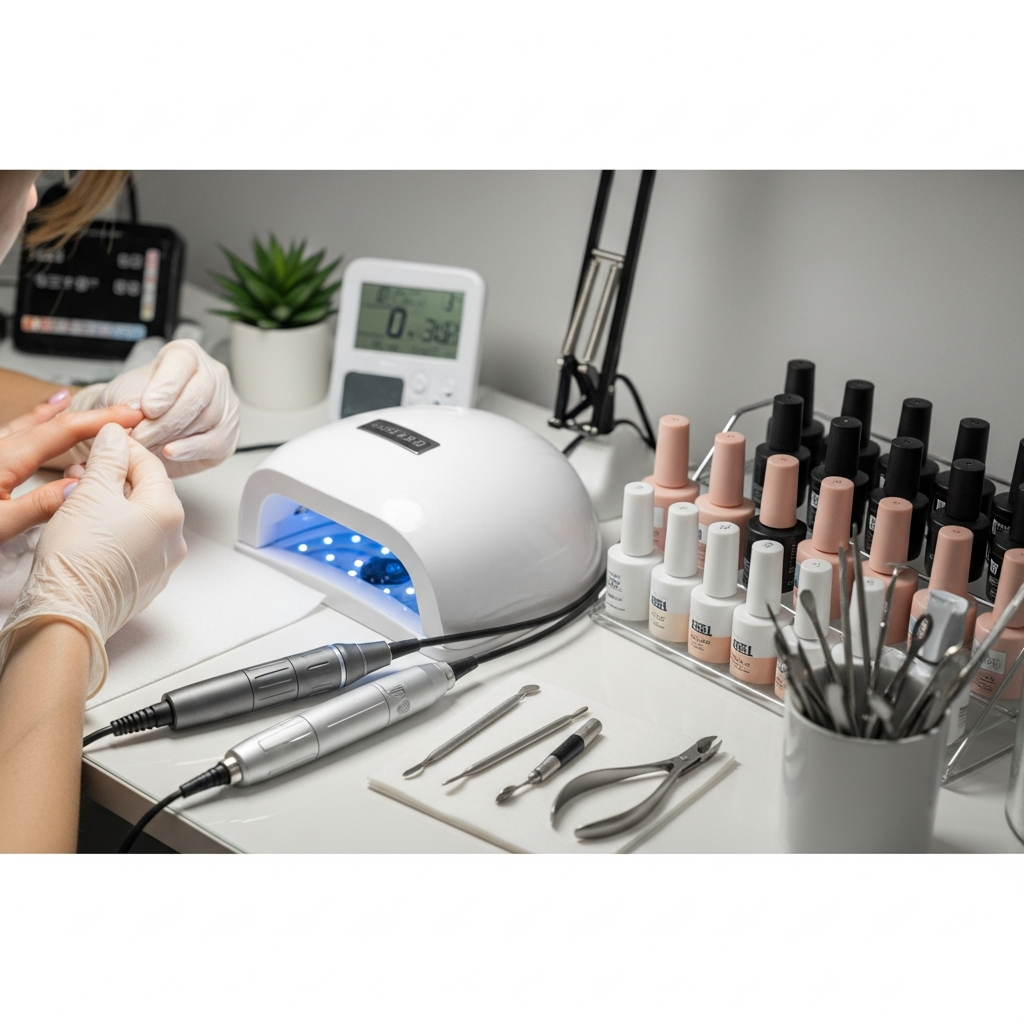
The physical layout of the nail station dictates the speed of the technician.
An unorganized station forces the technician to reach across their body or stand up frequently.
A standardized station setup ensures that all essential tools are within a specific “reach zone.”
For a right-handed technician, the e-file and handpiece should always be placed on the right side.
Monomer wells and polymer powders should be positioned to minimize the travel distance of the brush.
By keeping the most-used items closest to the dominant hand, you reduce physical fatigue and shave minutes off the service.
Implement a “kit system” for different nail services to further streamline the workflow.
A gel manicure kit, an acrylic full set kit, and a removal kit should be pre-organized in sanitized containers.
This prevents the technician from having to pull individual items from a communal supply closet during the appointment.
The 45-Minute Gel Manicure Workflow
In the US market, a standard professional gel manicure should ideally take 45 minutes.
Achieving this timeframe requires a “dry manicure” approach to prep, which is more efficient than traditional soaking.
Using an e-file for cuticle refinement and surface preparation significantly reduces the time spent on manual nipping.
The sequence of application is critical for maintaining a steady pace.
Technicians should work on all five fingers of one hand before moving to the next.
While one hand is curing under the UV/LED lamp, the technician should be performing the next step on the opposite hand.
Avoiding “over-painting” is another key to speed.
High-quality, highly pigmented professional gel polishes should require only two thin coats.
If a technician is consistently applying three or four coats, it indicates a product quality issue or a lack of brush control training.
Advanced Techniques for Acrylic and Builder Gel Speed
Nail enhancements like acrylic full sets and builder gel overlays are high-ticket services that demand efficiency.
The longest part of these services is often the finishing filing and shaping.
To reduce this time, technicians must master “one-bead” or “three-bead” application methods to create a smooth surface.
The more precise the product application is near the cuticle and side walls, the less filing is required.
A technician who spends 20 minutes filing an acrylic set is usually compensating for poor product control during the application.
Investing in advanced training for bead placement is the fastest way to increase service turnover.
Using the correct e-file bits for each stage of the service is also a non-negotiable standard.
Carbide bits are essential for bulk removal, while diamond bits should be reserved for delicate cuticle work.
Using the wrong bit for the job increases the risk of heat spikes and forces the technician to work slower to avoid injury.
Improving Fill-In and Rebalance Efficiency
Rebalance services, commonly known as “fills,” can often become more time-consuming than a new set if not managed correctly.
The technician must quickly identify areas of lifting and remove them without damaging the natural nail plate.
An efficient fill-in starts with a clear assessment of the nail’s structural integrity.
Instead of removing all the product, focus only on the growth area and any detached material.
Standardizing the amount of old product removed allows for a consistent application of the new material.
This ensures the nail maintains its apex and structural balance without adding unnecessary thickness.
- Check for lifting: Use a fine-grit bit to gently blend the transition area.
- Shortening: Use a coarse bit to reduce length before refining the shape.
- Surface Smoothing: Buff the entire nail surface to ensure seamless new product adhesion.
Sanitation and Safety as a Timed Component
Sanitation is a legal requirement in every US state, but it is often viewed as a “gap” in the schedule.
Successful salon owners integrate sanitation directly into the workflow to ensure it is never skipped.
Each technician must have a dedicated 10-15 minute window between clients specifically for disinfection.
The use of hospital-grade disinfectants and ultrasonic cleaners should be part of the visible salon culture.
While the tools are soaking, the technician can reset the station for the next guest.
This “clean as you go” philosophy prevents a mountain of dirty implements from accumulating at the end of the day.
Standardized sanitation checklists help ensure that every tech follows the same rigorous safety protocols.
These checklists should include wiping down the lamp, the armrest, and the e-file handpiece after every client.
Professionalism in sanitation builds trust, which is the foundation of client retention in the nail industry.
Managing Dust and Chemical Exposure
Effortless workflow is impossible if the environment is uncomfortable or hazardous.
High-quality source capture ventilation systems are essential for managing nail dust and monomer vapors.
When the air is clean, technicians can focus better and work faster without the distraction of respiratory irritation.
Owners should also provide ergonomic chairs and proper lighting for every station.
Technicians who are in physical pain due to poor posture will naturally slow down as the day progresses.
Efficient nail work requires a combination of sharp vision and a comfortable, stable working position.
Developing a Structured System for Professional Growth
To move beyond individual talent and create a scalable business, owners need a structured system for staff development.
Regular “speed drills” and technical workshops allow the team to refine their skills in a low-pressure environment.
These sessions should focus on the specific areas where the salon’s average service times are lagging.
Tracking the average service time per technician provides the data needed for constructive coaching.
If one tech consistently takes 90 minutes for a service that others complete in 60, there is a technical bottleneck.
Identifying whether the issue is in the prep, application, or filing allows for targeted training.
A salon management solution that includes performance tracking can help owners visualize these trends over time.
By rewarding efficiency that meets quality standards, you create a culture of excellence.
Technicians should be encouraged to share their “speed secrets” with their colleagues to elevate the entire team.
Optimizing the Client Hand-Off and Payment Process
The service ends when the client leaves the building, not when the top coat is cured.
The hand-off from the technician to the front desk or the payment system must be seamless.
Any confusion during the checkout process disrupts the flow of the next appointment.
Implement a clear pricing structure that accounts for “add-ons” like nail art or specialty shapes.
Technicians should clearly communicate any additional charges to the client during the service.
This prevents long discussions at the front desk, which can delay the start of the next client’s prep work.
Pre-booking the next appointment at the station can also save time.
When the client is already sitting with the technician, it is the perfect time to secure their next visit.
This reduces the administrative burden on the front desk and ensures the salon’s schedule remains full and efficient.
The Role of Retail in Professional Workflow
Retail sales should be a natural extension of the nail service, not a separate high-pressure pitch.
An efficient technician mentions aftercare products, such as cuticle oil or strengthening treatments, during the service.
By the time the client reaches the checkout, the decision to purchase should already be made.
This integration of retail into the service workflow increases the average ticket price without adding extra time to the appointment.
It also reinforces the technician’s role as a professional expert who cares about the long-term health of the client’s nails.
Proper aftercare also leads to fewer “emergency” repairs, which are often difficult to squeeze into a busy schedule.
Final Thoughts on Operational Excellence
Profitability in the nail industry is a game of minutes and consistency.
By standardizing the station, refining technical application, and integrating sanitation, owners can maximize their revenue.
Efficiency is the highest form of professionalism in a modern nail salon.
Focusing on the technical details of nail chemistry and tool usage empowers technicians to work with confidence.
A confident technician is a fast technician.
As the US nail market continues to evolve, those who master the balance of speed and quality will lead the industry.
Continuous improvement through a step-by-step framework ensures that your salon remains competitive and profitable.
The goal is to create a predictable, high-quality experience for every client who walks through the door.
Success in the nail business is built one perfectly executed service at a time.
