Mastering Professional Nail Prep to Prevent Lifting
Nail lifting is the separation of a gel or acrylic enhancement from the natural nail plate, often caused by improper preparation. To prevent lifting, technicians must perform thorough cuticle removal, surface dehydration, and precise product application. These professional techniques ensure structural integrity and long-term retention for all nail service types.
Primary Causes of Nail Enhancement Lifting
Incomplete Removal of Non-Living Tissue
The presence of pterygium or invisible cuticle on the nail plate is the most common cause of service failure.
Enhancement products cannot bond to skin or non-living tissue, creating a gap where lifting begins.
Technicians must use professional tools to meticulously clear the entire surface before application.
Inadequate Dehydration of the Nail Plate
Natural oils and moisture act as barriers between the nail plate and the enhancement material.
Failure to use a high-quality dehydrator results in a temporary bond that quickly fails under daily wear.
A clean, chalky surface is the professional standard for ensuring product adhesion.
Technical Steps for Optimal Retention
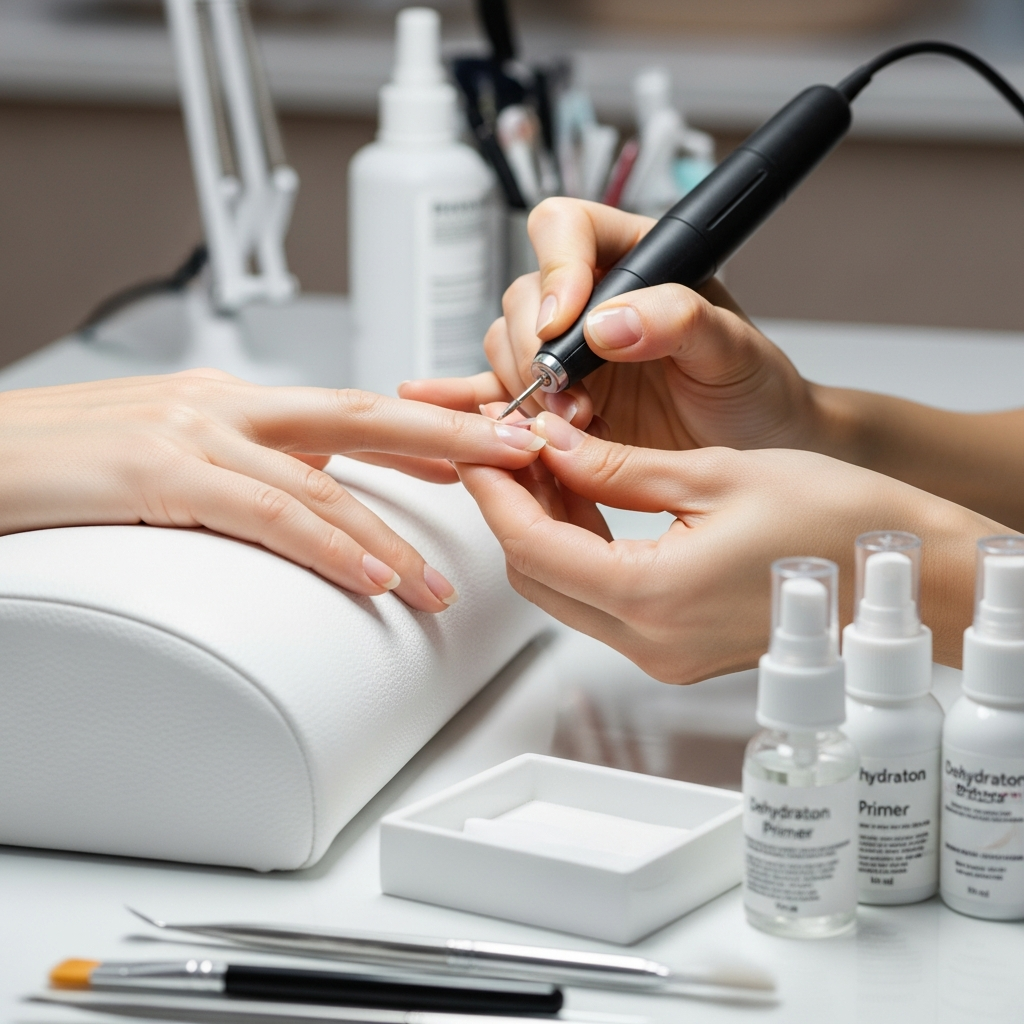
Executing a Precise Dry Manicure
A dry manicure is preferred for professional nail services to avoid swelling the nail plate with water.
Use a fine-grit e-file bit or a manual pusher to gently lift and remove the cuticle from the plate.
This ensures the product sits directly on the keratin layers for maximum physical grip.
Balancing PH with Primers and Bonders
Applying a pH balancer and a site-specific primer prepares the nail for chemical bonding.
Acid-based primers provide a deep etch, while acid-free versions act like double-sided tape for the product.
Choosing the correct agent depends on the client’s nail health and the specific system being applied.
Strategic Product Placement and Perimeter Control
Product touching the proximal nail fold or lateral walls is a guaranteed point of failure.
Leave a tiny margin—the thickness of a hair—between the product and the surrounding skin.
Smooth, tapered edges at the cuticle area prevent snagging and subsequent lifting as the nail grows.
Professional Standards for Client Safety
Identifying Nail Plate Damage
Over-filing the nail plate during preparation leads to thinning and increased sensitivity for the client.
A thin or damaged plate lacks the structural integrity to support heavy gel or acrylic enhancements.
Technicians should only remove the surface shine using a high-grit buffer to preserve plate health.
Sanitation and Tool Maintenance
Contaminated tools can introduce bacteria under a lifting enhancement, potentially causing a “greenie” or infection.
All metal implements must be cleaned and processed in a high-level disinfectant between every nail service.
Proper sanitation protocols protect both the technician and the client during technical execution.
