Mastering Advanced Nail Structure in the United States Nail Salon
Achieving structural integrity is the hallmark of a senior nail technician. In a high-volume United States nail salon, balancing speed with technical precision ensures long-lasting results.
Professional nail enhancements require a deep understanding of physics and chemistry. Proper architecture prevents service breakdowns and ensures the safety of the natural nail plate.
The Architecture of a Professional Nail Enhancement
A well-constructed nail enhancement must withstand daily mechanical stress. Technicians must focus on the relationship between the apex, the side walls, and the free edge thickness.
Every set performed in a United States nail salon should follow standardized structural rules. This consistency builds client trust and reduces the frequency of emergency repair appointments.
Strategic Apex Placement for Different Lengths
The apex serves as the stress point’s primary reinforcement during wear. For short salon squares, place the apex at the mid-point of the natural nail plate to prevent lifting.
For long coffin or stiletto extensions, shift the apex slightly toward the proximal nail fold. This counteracts the increased leverage and prevents traumatic plate snapping at the hyponychium.
Maintain a seamless transition from the apex to the cuticle area. A bulky cuticle application causes snagging and premature lifting of the gel or acrylic system.
Perfecting the C-Curve and Side Wall Alignment
A consistent C-curve provides the mechanical strength needed for daily durability. Aim for a 30% to 40% curvature depending on the specific nail system and length being applied.
Ensure side walls remain parallel from the growth point to the free edge. Over-filing the side walls weakens the foundation and leads to premature structural failure under pressure.
Use pinching tools or precise form placement to lock in the C-curve during the polymerization process. This step is critical for maintaining a slim, professional profile on the nail.
Refined Filing Techniques for Surface Consistency
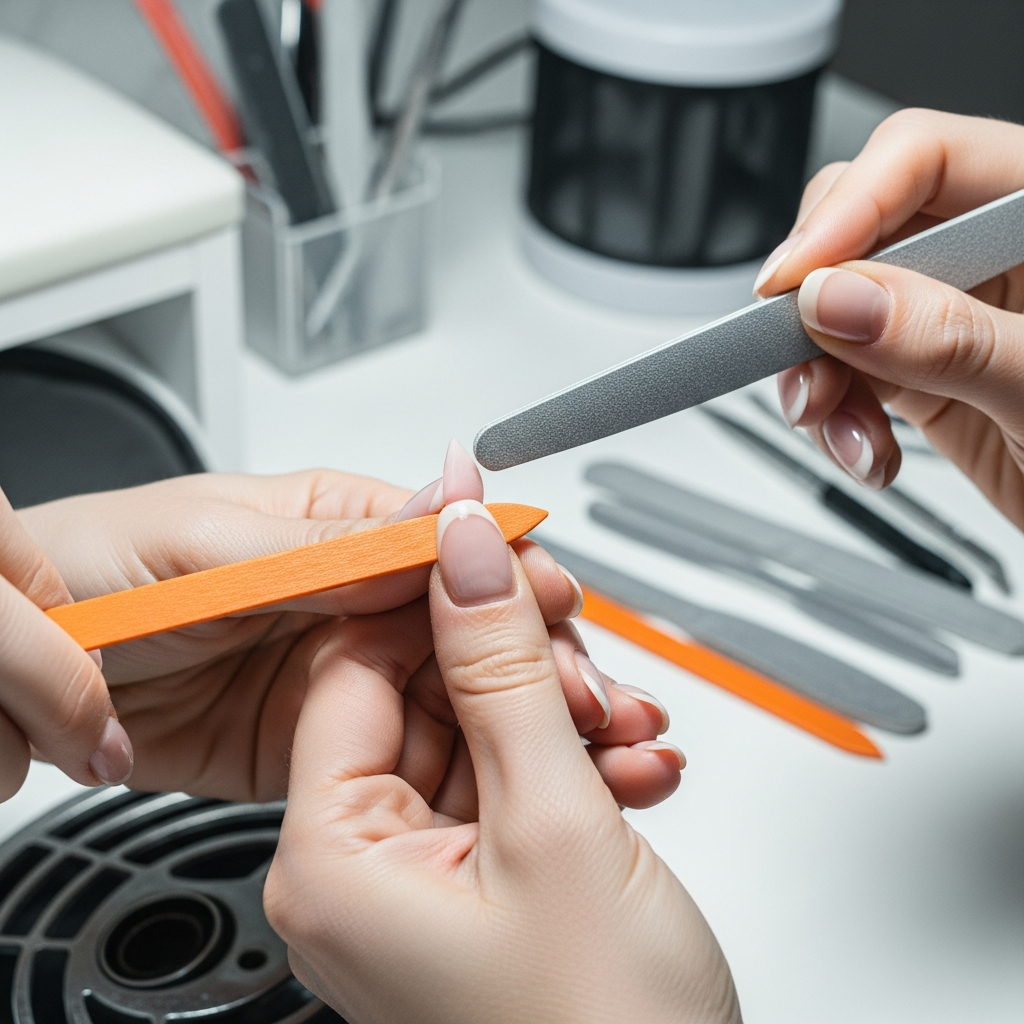
Use a 180-grit file for initial shaping and a 100/180 buffer for final smoothing. Technicians must maintain a consistent file angle to avoid thinning the product at the stress zone.
Check the architecture from the side view and the barrel view. This dual-perspective check ensures the enhancement meets professional United States nail salon quality standards.
Refining the lower arch is just as important as the top surface. A straight lower arch ensures the nail does not appear to “droop” or “hook” as it grows out.
Professional Execution Workflow
- Prep the natural nail plate using a 240-grit buffer to remove shine.
- Apply the appropriate bond and primer for the specific chemical system.
- Build the architecture using a precise three-zone application method.
- Refine the surface shape using e-file mandrels or professional hand files.
- Seal the enhancement with a high-shine, soak-off or hard gel top coat.
Adhering to these technical standards elevates the service quality of any United States nail salon. Mastering these skills allows for faster service times without sacrificing the structural integrity of the work.
Consistent practice of apex placement and C-curve refinement leads to a superior professional reputation. Understanding the “why” behind nail architecture is the key to technical mastery.
