Mastering Professional Nail Prep to Prevent Lifting
Professional nail lifting occurs when the enhancement separates from the natural plate, often due to improper surface preparation or incorrect product application. To ensure maximum nail retention, technicians must remove the non-living cuticle, dehydrate the nail plate thoroughly, and apply primers or base gels with precise margin control to prevent pocket lifting.
The Fundamentals of Mechanical Nail Preparation
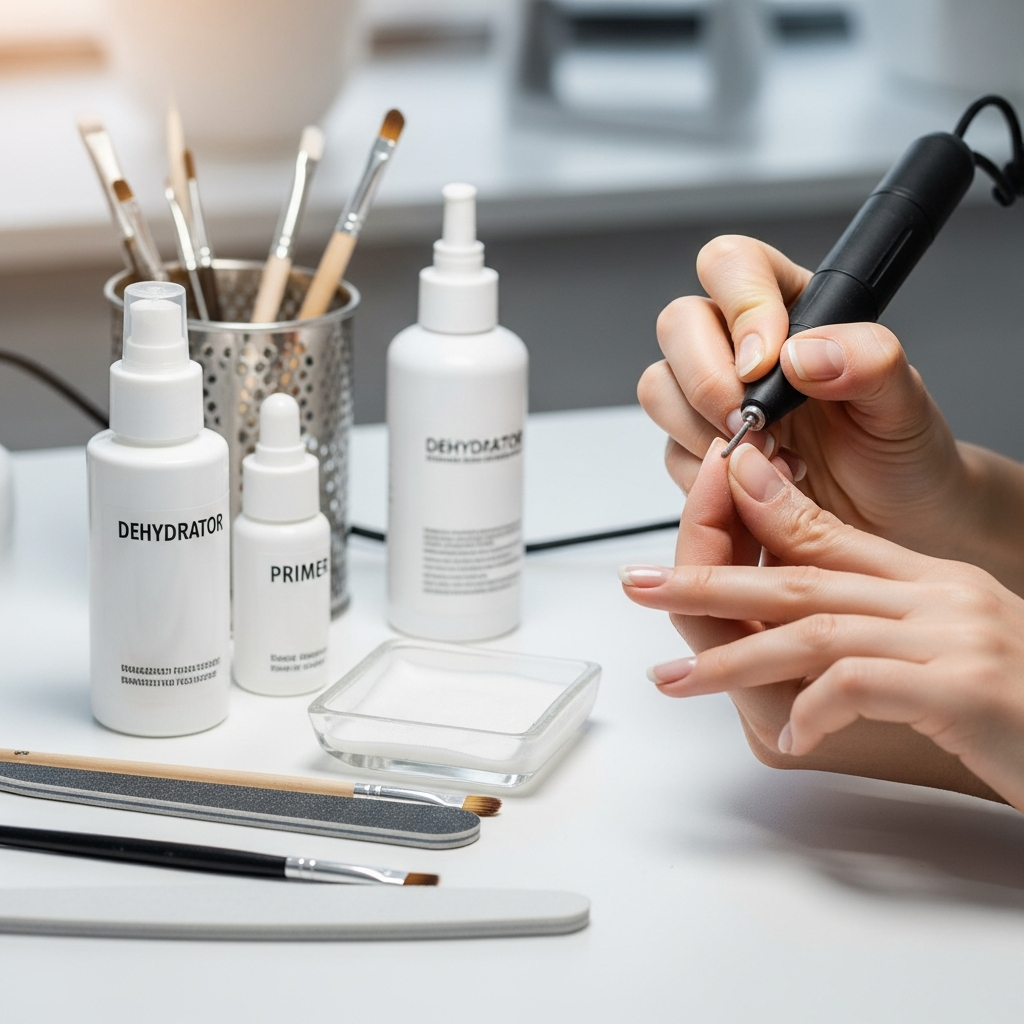
Successful nail enhancement longevity begins with thorough mechanical preparation of the natural nail plate. Using a high-quality 180-grit file or a fine-grit e-file bit, technicians must gently remove the surface shine to create a receptive texture for product adhesion.
Removing the non-living tissue, or true cuticle, from the nail plate is critical. Any protein debris left behind acts as a barrier, preventing the gel or acrylic from bonding securely, which inevitably leads to premature lifting at the proximal nail fold.
Technicians should focus on the lateral folds and the eponychium area. Ensuring these zones are completely clean of debris allows the product to sit flush against the nail without touching the surrounding skin.
Chemical Preparation and Dehydration Standards
After mechanical prep, the nail plate must be chemically cleansed to remove oils and moisture. A professional-grade dehydrator should be applied to temporary balance the pH and dry out the top layers of the nail cells.
The choice between acid-based and acid-free primers depends on the client’s nail type and the specific product system used. Acid-free primers act like double-sided tape, creating a covalent bond between the natural nail and the enhancement material.
Consistency is key when applying these chemicals. Over-saturation can lead to chemical sensitivity, while under-application can result in weak bonding points that fail under the daily stress of nail wear.
Advanced Application Techniques for Durability
Maintaining Proper Structure and Apex
Incorrect structure is a leading cause of mechanical nail lifting. If the apex is placed too far forward or is too thin, the enhancement will lack the necessary support to withstand impact, causing the product to pull away from the free edge.
Technicians must ensure the thickest part of the nail enhancement is positioned over the stress area. This balanced architecture distributes weight evenly across the nail plate, reducing the risk of cracks and lifting.
Avoiding Skin Contact and Flooding
Product flooding into the side walls or cuticle area is a primary technical error. Once the gel or acrylic touches the skin, it creates a bridge that will eventually break, allowing moisture to enter the nail gap.
To prevent this, maintain a tiny margin between the product and the soft tissue. Using a thin liner brush for detail work around the perimeter ensures a clean, professional finish that remains sealed for weeks.
Common Mistakes in the Curing Process
Incomplete curing often leads to internal lifting that is not immediately visible. Technicians must ensure their lamps are compatible with the specific nail professional brand being used to guarantee a full polymer chain reaction.
Regularly cleaning the bulbs or sensors in a nail lamp is vital for consistent performance. Weak light output results in “under-baked” product, which is soft near the nail plate and prone to peeling or lifting.
Properly positioning the client’s hand inside the lamp is also crucial. If the thumb is tilted, the nail may not receive direct light, leading to uneven curing and localized lifting issues.
