Mastering Professional Nail Structure and Apex Placement
Professional nail structure is the strategic application of product to provide balance and strength to an enhancement. It involves building a reinforced apex at the stress zone while maintaining thin perimeters at the cuticle and free edge to ensure the nail remains durable under daily pressure and prevents lifting.
The Role of the Apex in Nail Durability
The apex is the highest point of a nail enhancement, positioned directly over the stress area of the natural plate. This reinforcement acts as a fulcrum, distributing the weight of the extension and protecting the natural nail from snapping under force.
In professional U.S. salon standards, the placement of the apex depends on the length of the extension. For shorter nails, the apex is usually closer to the center, while longer extensions require the apex to be moved slightly back toward the cuticle area.
Failing to build a proper apex results in a flat architecture. This leads to premature cracking at the sidewalls and increases the risk of painful nail plate damage for the client during daily activities.
Technical Requirements for Secure Nail Prep
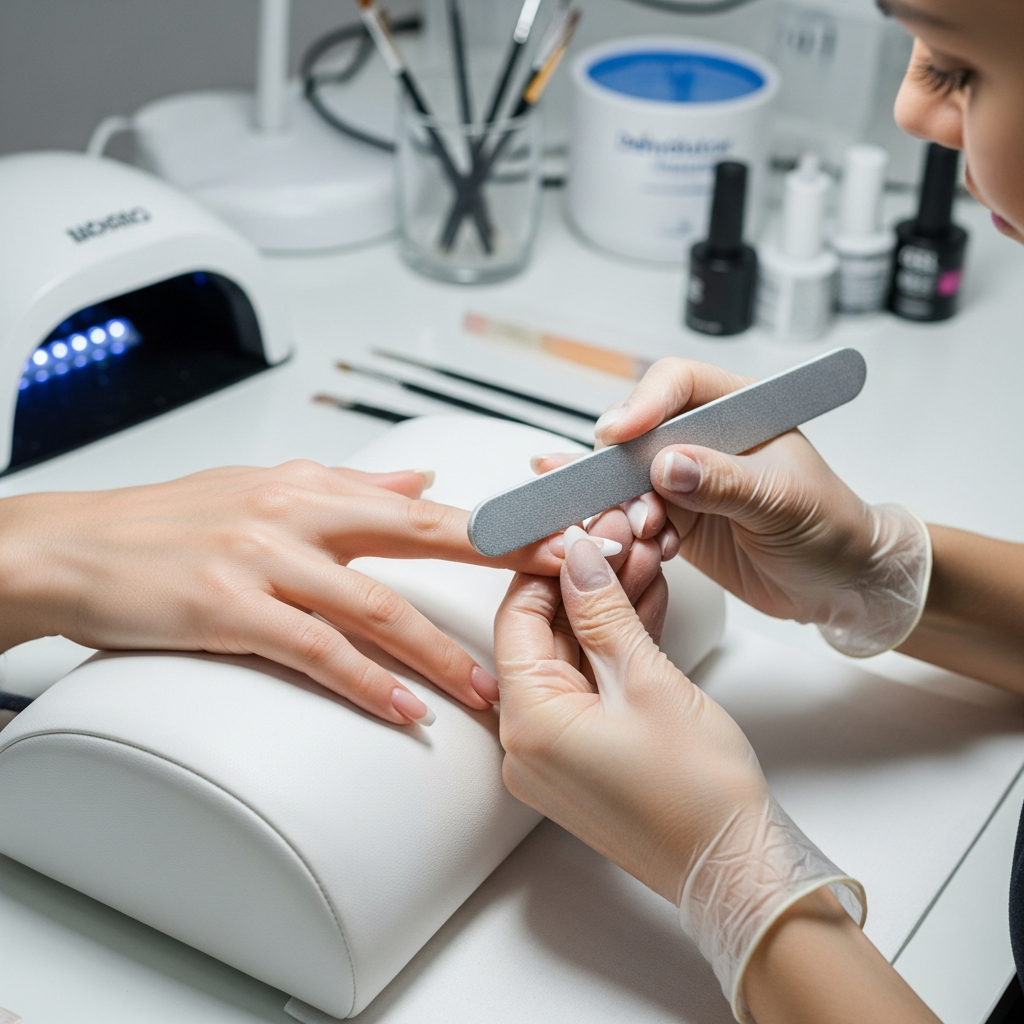
A structurally sound nail begins with meticulous preparation to ensure maximum product adhesion. Technicians must remove all non-living tissue from the nail plate, specifically focusing on the pterygium at the proximal fold.
Using a high-quality dehydrator and a professional-grade primer is essential to balance the pH of the natural nail. This chemical bond creates the foundation needed for gel, acrylic, or builder gel to remain stable and resist lifting.
Technicians should also ensure the surface is etched correctly with a medium-grit file. This increases the surface area for the product to grip without thinning the natural nail plate excessively.
Correcting Common Structural Failures
Structural failures often occur when product is applied too thickly at the sidewalls or the cuticle area. These “heavy” zones create leverage that pulls the enhancement away from the natural nail, leading to service breakdown.
Managing Sidewall Thickness
Sidewalls must be kept straight and parallel to the natural growth of the nail. Over-filing the sidewalls can weaken the foundation, while under-filing creates a bulky appearance that traps debris and moisture.
The transition from the apex down to the sidewalls should be a smooth, tapered curve. This ensures the nail remains aesthetically pleasing while maintaining the necessary strength for three to four weeks of wear.
Refinement Filing for a Professional Finish
Final shaping and refinement filing are critical for achieving a balanced nail structure. Using a consistent filing routine ensures that each nail on the client’s hand has a uniform shape and thickness.
Checking the C-curve from the front view allows the technician to verify that the product thickness is consistent across the entire free edge. A professional finish should look slim and natural but feel rigid and supportive.
- Apex Placement: Reinforces the stress zone to prevent breakage.
- Thin Perimeters: Prevents lifting at the cuticle and free edge.
- C-Curve Balance: Provides longitudinal strength and structural integrity.
