Mastering Professional Nail Prep for Long-Term Gel Retention
Professional nail preparation involves removing surface oils, debris, and non-living tissue from the nail plate to ensure maximum adhesion of enhancements. By performing thorough cuticle work and dehydrating the natural nail, technicians prevent premature lifting and peeling, ensuring the durability and integrity of gel, acrylic, or dip powder services.
Eliminating Non-Living Tissue and Surface Contaminants
The primary cause of nail enhancement failure is improper removal of the cuticle. This non-living tissue remains attached to the nail plate and prevents the gel or acrylic from bonding directly to the keratin.
Technicians must use a professional-grade pusher or an e-file with a diamond bit to gently clear the proximal nail fold. Any remaining skin creates a barrier that leads to immediate lifting once the nail begins to grow.
After mechanical cleaning, surface oils must be neutralized. Natural lipids on the nail plate act as a lubricant, which causes product rejection if not thoroughly cleansed with a high-percentage isopropyl alcohol or specialized dehydrator.
The Role of Mechanical and Chemical Etching
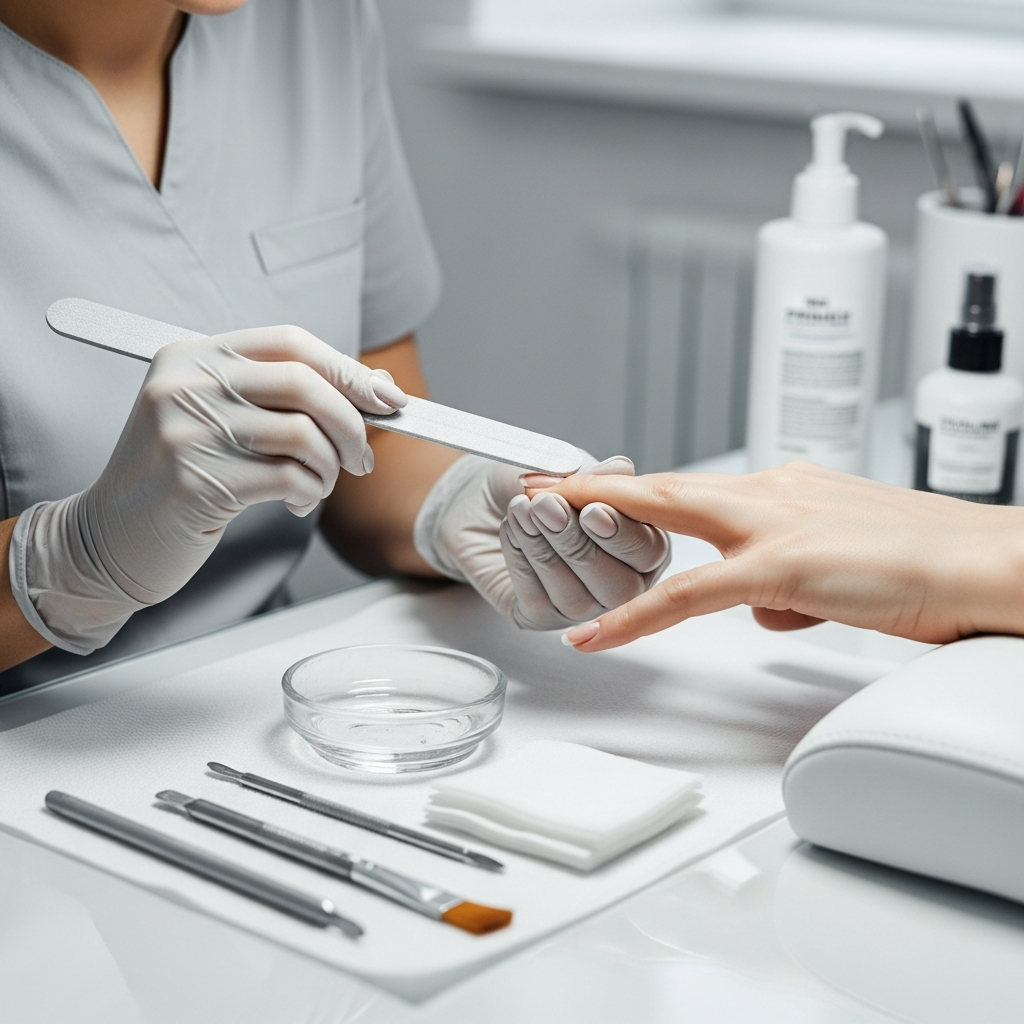
Creating a proper surface profile is essential for mechanical bonding. Using a 180-grit to 240-grit file, a technician should remove the shine from the entire nail surface without thinning the natural plate.
Over-filing the nail plate compromises structural integrity and leads to flexible, weak nails that cannot support enhancements. The goal is to raise the keratin scales slightly to allow the base coat to anchor firmly.
- Mechanical Prep: Buffing and filing to create surface area.
- Chemical Prep: Using acid or non-acid primers to create a chemical bond.
- Dehydration: Removing moisture to stabilize the nail surface.
Correct Application to Prevent Side-Wall Lifting
Precision during the application phase is just as critical as the prep work. If a professional nail product touches the lateral folds or the eponychium, it creates a bridge between the skin and the plate.
As the skin moves and produces natural oils, it pulls the product away from the nail. Maintaining a small margin, often referred to as the “hairline gap,” ensures the product is sealed only to the hard nail surface.
Optimizing the Nail Surface for Maximum Adhesion
Environmental factors in the salon, such as dust or high humidity, can interfere with the nail bonding process. Ensure the nail plate is scrubbed with a lint-free wipe to remove all filing debris before applying the first layer.
Using a high-quality primer tailored to the specific nail type—such as a protein bonder for oily nails—provides an additional layer of security. This step is vital for clients who experience frequent lifting issues.
Properly prepped nails provide a consistent foundation for apex building and structural shaping. When the foundation is secure, the service lifespan increases, leading to higher client satisfaction and professional results.
