Essential Professional Nail Preparation for Long-Term Retention
Nail preparation is the process of cleaning and dehydrating the natural nail plate to ensure maximum adhesion of professional enhancement products. Proper nail prep involves removing non-living tissue from the cuticle area, buffing the surface to remove shine, and using a pH balancer to prevent lifting and ensure long-term service durability.
Understanding the Role of the Nail Plate in Retention
Professional nail services rely heavily on the quality of the initial preparation steps.
Failure to remove oils, moisture, and debris results in premature lifting and product failure.
Technicians must focus on the anatomy of the nail to achieve a perfect bond every time.
The nail plate must be free of all non-living tissue to prevent pockets of air.
These air pockets allow moisture to seep under the enhancement, leading to bacterial growth.
Proper prep ensures the enhancement becomes a seamless extension of the natural nail.
Mechanical Preparation Steps for Maximum Adhesion
Removing the Eponychium and Pterygium
Begin by pushing back the proximal nail fold to reveal hidden cuticle growth on the plate.
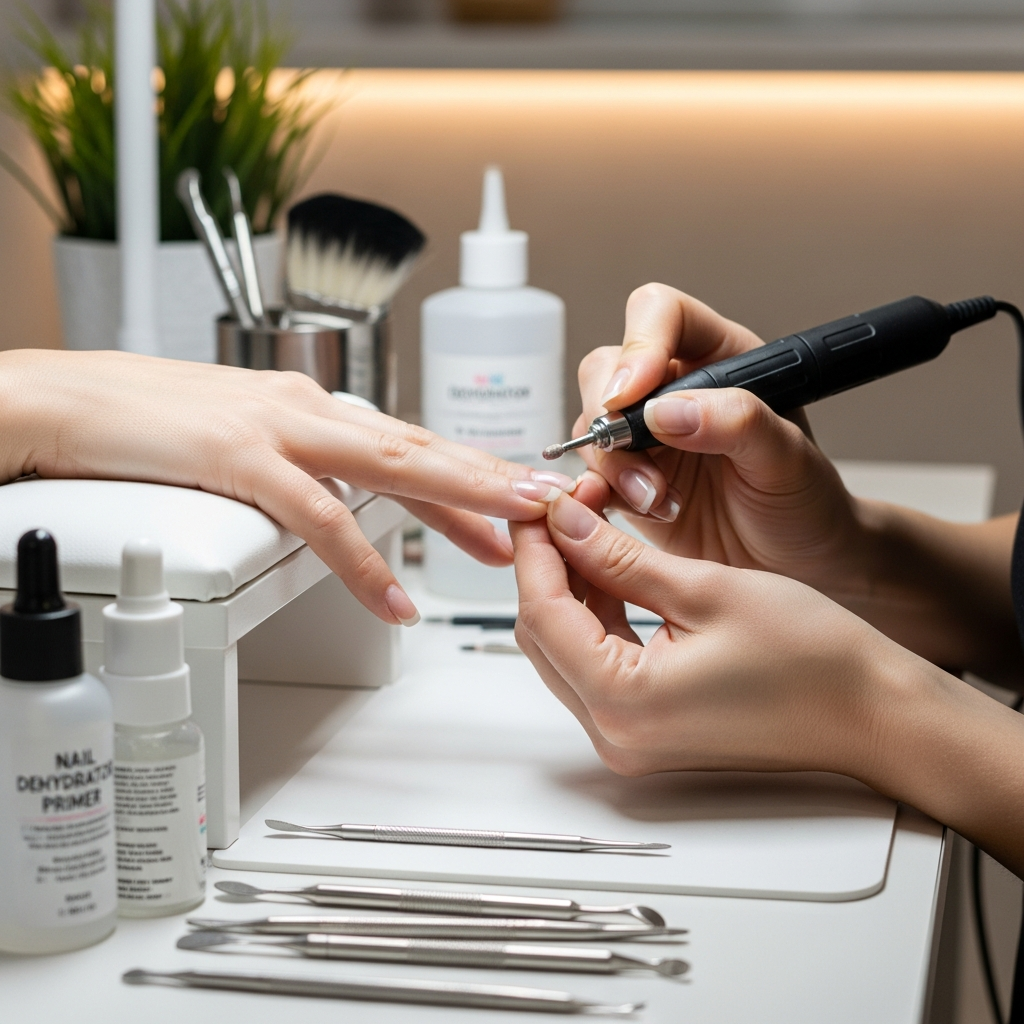
Use a high-quality curette or specialized e-file bit to remove all non-living tissue carefully.
Removing the pterygium is vital because enhancements will not bond to skin or dead tissue.
Proper Surface Buffing Techniques
Avoid over-filing the natural nail plate, as this thins the keratin layers and causes sensitivity.
Use a 180-grit file or buffer to gently remove the surface shine from the entire nail.
This creates the necessary texture for mechanical bonding without causing structural damage.
Clearing Debris and Dust
Dust removal is critical before applying any chemical dehydrators or adhesive primers.
Use a stiff-bristled brush to clear debris from the nail sidewalls and lateral folds.
Any remaining dust can create a physical barrier that prevents the product from adhering.
Chemical Dehydration and Priming
The Importance of pH Balancing
Apply a professional nail dehydrator to remove moisture and surface oils temporarily.
This chemical step balances the pH of the nail plate, making it receptive to bonding agents.
The effect is temporary, so work in small batches to ensure the nail remains dehydrated.
Selecting the Right Nail Primer
Follow dehydration with an acid or non-acid primer based on the client’s specific nail type.
Acid primers are effective for oily nail plates, while non-acid primers act as double-sided tape.
Ensure the primer does not touch the surrounding skin to prevent irritation or chemical burns.
Maintaining Client Safety During Prep
Always use sanitized and disinfected tools for every nail service to prevent cross-contamination.
Monitor the thickness of the natural nail to ensure it remains strong enough to support the product.
Education on proper nail plate health ensures long-term client retention and service safety.
